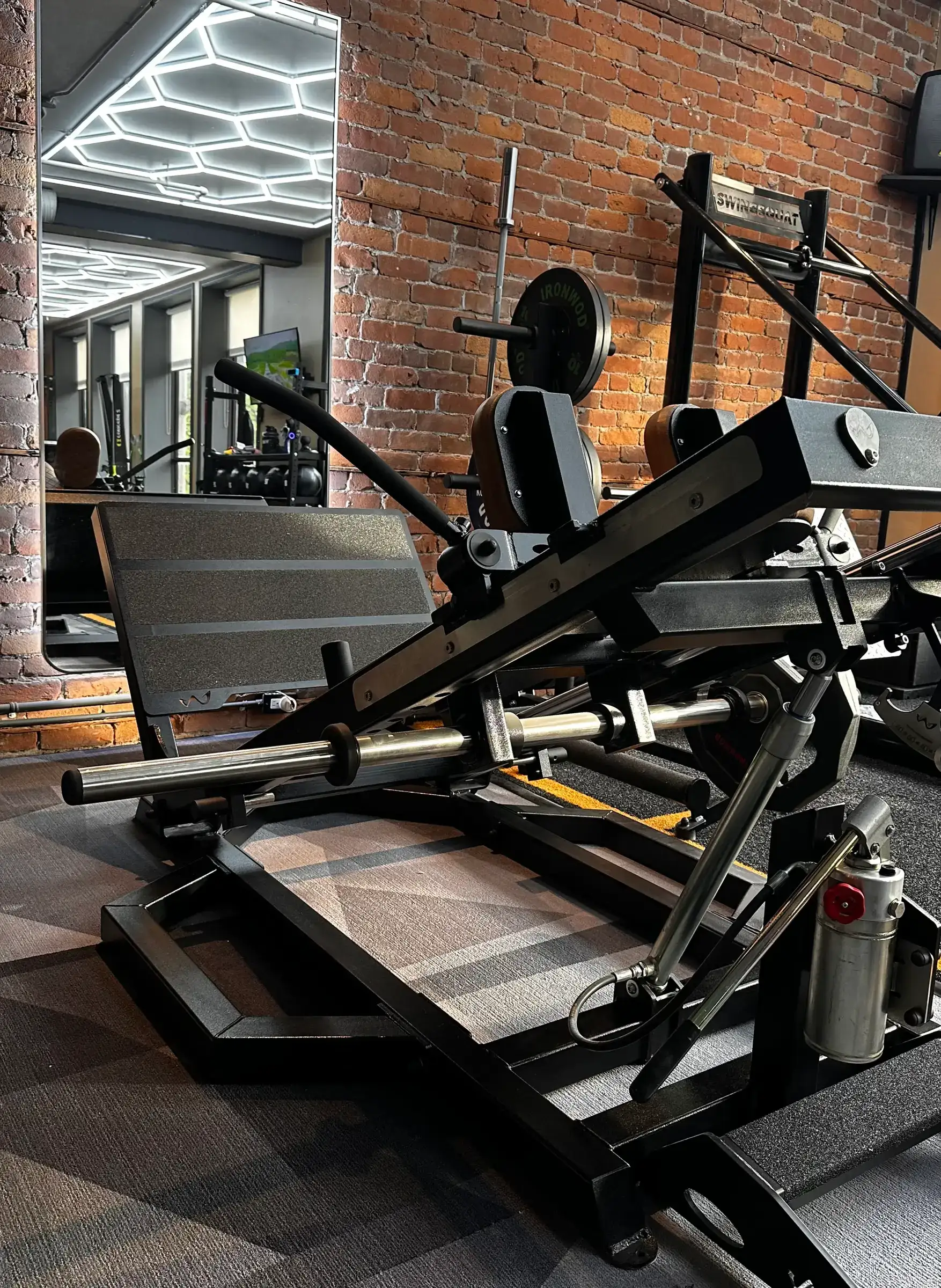
Personal training after knee surgery in Vancouver
ACL, meniscus or a new knee. Once your surgeon or physiotherapist has cleared you, we build the strength back, alongside them.
The honest first answer. We are on the second floor, about 18 stairs up, with no elevator. If stairs are not possible for you yet, call us first.
The surgery is done. The strength is still to build.
A year after ACL surgery, the front of the thigh averages 14% weaker than the other side. A month after a knee replacement, one study measured it 62% down on where it was before surgery. That is the part training works on, once you are cleared.
Who it is for
Four knees, one starting point
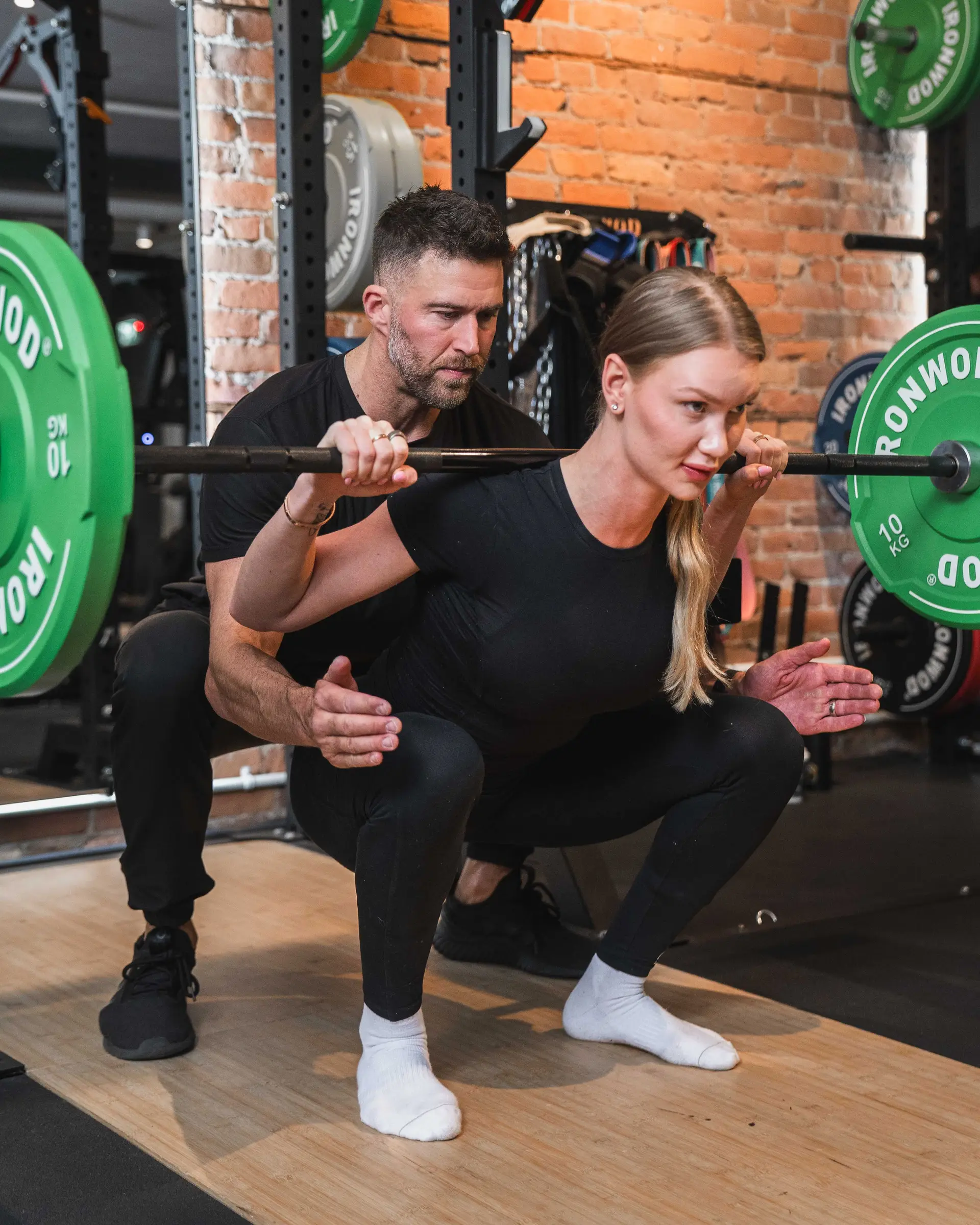
Your clinician’s limits. Wherever they allow, much of the work is one leg at a time, so the stronger side cannot quietly do the weaker side’s work.
- After ACL reconstruction
- The front of the thigh first, then single-leg strength, then landing and changing direction, each one when your clinician clears it.
- After meniscus surgery
- Loaded with care, inside the depth and impact limits your surgeon gives you.
- After a knee replacement
- Getting the muscle to switch on fully, then strength for stairs, standing up and walking further.
- With osteoarthritis
- No surgery needed. Both major guidelines put exercise at the core of care for an arthritic knee. We make it coached, loaded and logged.
How it works
Your clinician sets the limits, we train inside them
Cleared
Your surgeon or physiotherapist clears you for exercise. Bring their limits in writing, or their notes. We keep them on file.
Point Zero
An hour with a coach. We take your history, see how you move inside those limits and, with your permission, contact your clinician so our plan matches theirs.
Coached
Every session with your coach beside you. Every set logged in the Vanguard app, so your clinician can see exactly what you did between appointments.
If a set looks wrong, it stops. You go back to your clinician before we go on. New to Vanguard? Point Zero is free.
Back to sport
We do not decide when you go back. We build what the test measures.
Your surgeon or physiotherapist makes that call, usually after strength and hop tests that compare one leg with the other. Every set you do here is logged in the Vanguard app, so they can see the work behind the number.
The research
What the research says about the knee
Six papers, each one linked. They are the reason the training looks the way it does.
Lepley, 2015 · Sports Health
Review of the published studies after ACL reconstruction
Quadriceps strength averaged 23% below the other leg six months after surgery, and 14% below at twelve months. The review describes these as the deficits that remain when formal physiotherapy ends.
Read the paper by Lepley, 2015 (opens in a new tab)Grindem, Snyder-Mackler, Moksnes et al., 2016 · Br J Sports Med
Cohort · n = 106 athletes after ACL reconstruction · 2 years
More even quadriceps strength between the legs before going back to sport went with significantly fewer knee reinjuries. So did returning nine months or more after surgery.
Read the paper by Grindem, 2016 (opens in a new tab)Kyritsis, Bahr, Landreau et al., 2016 · Br J Sports Med
Cohort · n = 158 professional athletes after ACL reconstruction
Athletes who returned without meeting all six discharge tests, strength and hopping among them, had about four times the risk of rupturing the graft.
Read the paper by Kyritsis, 2016 (opens in a new tab)Mizner, Petterson, Stevens et al., 2005 · J Bone Joint Surg Am
Cohort · n = 20 · before and about a month after a knee replacement
Quadriceps strength was 62% below its level before surgery. Most of the loss came from the muscle failing to switch on fully, rather than from the muscle shrinking.
Read the paper by Mizner, 2005 (opens in a new tab)Bannuru, Osani, Vaysbrot et al., 2019 · Osteoarthritis Cartilage
Guideline · Osteoarthritis Research Society International
Structured land-based exercise is one of the core recommendations for knee osteoarthritis.
Read the paper by Bannuru, 2019 (opens in a new tab)Kolasinski, Neogi, Hochberg et al., 2020 · Arthritis Care Res
Guideline · American College of Rheumatology and the Arthritis Foundation
Exercise is strongly recommended for people with knee osteoarthritis.
Read the paper by Kolasinski, 2020 (opens in a new tab)
Research describes groups of people, not your knee. None of it is a promise about your recovery, and none of it replaces your clinician's advice.
The specifics
What it costs, and where
- Format
- 1-on-1, or 2-on-1 with a partner. A coach for every set, never a class.
- Session
- 50 minutes.
- Price
- $126 to $147 a session, GST included. The rate depends on how often you train and whether you choose month-to-month or a year.
- First session
- Point Zero. An hour with a coach, free, with nothing to join.
- Where
- 420 West Hastings, Suite 200, a block from Gastown. Second floor, about 18 stairs, no elevator.
- Hours
- Monday to Friday 6am to 8pm. Saturday 8am to 6pm. Closed Sunday.
- Recovery
- Infrared sauna at 45 to 65°C and cold plunge at 3 to 7°C, included with training.
- Benefits
- Many lifestyle spending accounts reset on 31 December. Training often qualifies. Check your plan.
Updated . Signed by Maria, Owner and Master Coach.
Frequently Asked Questions
Your first session
Start with Point Zero
An hour with a coach. Bring your clearance. Nothing to pay and nothing to join.