The Vanguard app · Build muscle
Tone, shape or size, it is all muscle
Hard sets build it, and the app counts every one: per muscle, every week, with the reason for every change.
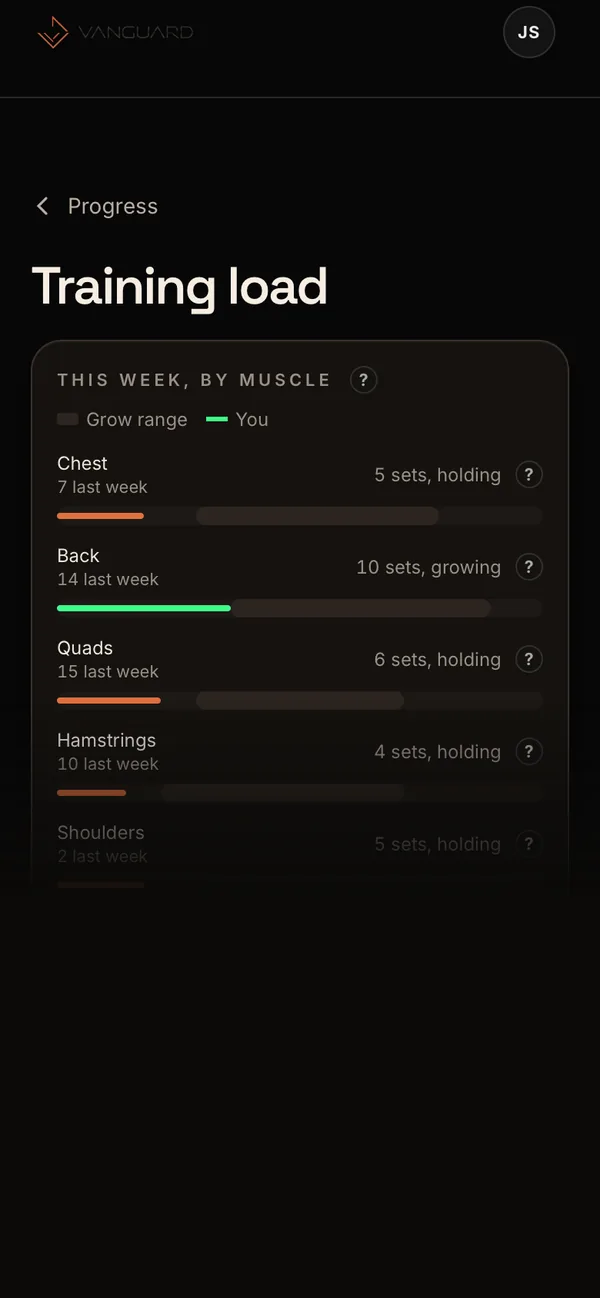
Sample member. Real screen.
Your focus
Choose where the work goes
Choose Build muscle and the app asks one more thing: where you want the focus. It picks the program on its shelf that fits, then lists the others beneath it in order of fit.
- EverythingA balanced split
- LegsQuads, hamstrings, calves
- GlutesHip thrusts and single-leg work
- Chest and backUpper-body width and thickness
- Shoulders and armsThe things people notice
Sets per muscle
Counted per muscle, every week
Hard sets in a week, each counted toward the one muscle its exercise trains most. Muscle size rises with weekly hard sets across the research, so the app counts your week in them.
- Holding
- Under where growth starts for this muscle.
- Growing
- Between where growth starts and the redline. Each extra set buys a little less.
- At redline
- The most sets this muscle is set to recover from. The app stops adding here.
- Back6 sets, holding
- Chest14 sets, growing
- Quads20 sets, at redline
Where growth starts and where the redline sits are a coach’s estimate for each muscle, and the app’s “?” says so. The grade for each.
Week to week
More sets while your lifts climb
- Adds while you climb
- When a muscle's lifts hold or go up, the app adds sets, a set at a time, and never past the redline.
- Spread, not stacked
- An added set goes to that muscle's slot with the fewest sets, never piled onto one exercise.
- A stall asks once
- When a muscle's lifts stall, the app asks about soreness and pump for it, once that week. A sore answer holds what would have been added.
- Pain holds the muscle
- Joint pain, noted with one tap, holds that muscle's sets rather than adding to them.
The block
A block that builds, then resets
On a strength block the app wrote, each week has a name and a job.
- Settle
- The first week of a block. A touch lighter while the app learns you.
- Build
- Sets and effort go up each week.
- Redline
- The hardest week of the block, on purpose.
- Reset
- A lighter week: fewer sets, lighter loads, well short of failure.
The research
What the research says about building muscle
Six papers, each one linked. They are why the app counts what it counts.
Schoenfeld, Ogborn, Krieger, 2017 · J Sports Sci
Meta-analysis
Each extra weekly set added about 0.37% to the gain in muscle size.
Read the paper by Schoenfeld, Ogborn, Krieger, 2017 (opens in a new tab)Pelland, Remmert, Robinson et al., 2026 · Sports Med
Meta-regressions · 67 studies · 2,058 people
Four weekly sets was the smallest dose with detectable growth; each further step took more sets (about 6 between 5 and 10 sets, about 10.75 between 19 and 29). Indirect sets counted as half fitted best. 78% of the growth data came from sets to failure.
Read the paper by Pelland, Remmert, Robinson et al., 2026 (opens in a new tab)Baz-Valle, Fontes-Villalba, Santos-Concejero, 2021 · J Strength Cond Res
Systematic review · 14 trials
Counting sets taken to or near failure is a valid measure of volume for sets of about 6 to 20 or more reps.
Read the paper by Baz-Valle, Fontes-Villalba, Santos-Concejero, 2021 (opens in a new tab)Baz-Valle, Balsalobre-Fernández, Alix-Fages et al., 2022 · J Hum Kinet
Systematic review · 7 trials · trained men
Moderate (12 to 20) against high (over 20) weekly sets: no difference for quadriceps or biceps; high was better for triceps.
Read the paper by Baz-Valle, Balsalobre-Fernández, Alix-Fages et al., 2022 (opens in a new tab)Refalo, Helms, Trexler et al., 2023 · Sports Med
Meta-analysis · 15 studies
Training to failure gave a trivial edge in growth (effect size 0.19); momentary failure against stopping short, 0.12, not significant.
Read the paper by Refalo, Helms, Trexler et al., 2023 (opens in a new tab)Roberts, Nuckols, Krieger, 2020 · J Strength Cond Res
Meta-analysis · the same program in men and women · young to middle-aged adults
No difference between the sexes in muscle growth (10 studies) or lower-body strength (23 studies). Women gained more upper-body strength relative to where they started (17 studies). The studies were mostly short, and the authors ask whether that edge is learning rather than muscle.
Read the paper by Roberts, Nuckols, Krieger, 2020 (opens in a new tab)
Research describes groups of people, not you, and none of it is a promise about you.
Frequently Asked Questions
Read on
The other goals
- Get strongThe squat, bench, deadlift and press, set from your own estimated max.
- Get leanerLifting the whole way down, with a heavy week held rather than piled on.
- Move better for lifeGetting off the floor, carrying, holding a position under load.
- Build an engineConditioning set per machine, with strength alongside it.
- Train for a raceA run or a hybrid race on the calendar, worked back from race day.
The Vanguard app
Try it on your own training
Fourteen days free, then $19.99 a month or $199 a year, in Canadian dollars. In your browser, on any phone or computer. Cancel in the app in two taps.