The Vanguard app · Train for a race
Work back from race day
A run or a hybrid race on the calendar. The app works back from the date and your goal, and reads every run you log against your own zones.
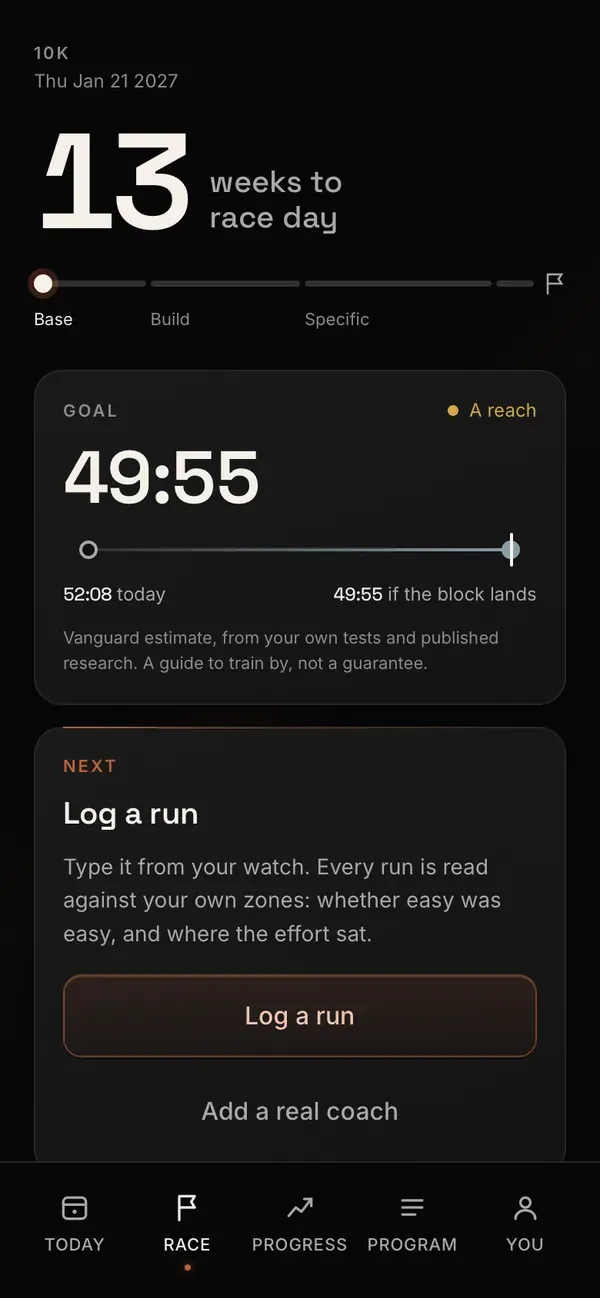
Sample member. Real screen.
The Race tab
Set the race, one question at a time
Race is one of the app’s tabs on every account. Setting a race asks one thing a screen: the race, the date, your running lately, a recent race if you have one, and the goal.
- Four distances
- A 5K, a 10K, a half marathon or a marathon.
- A goal in plain words
- Run what you are capable of, break a barrier, your own time, or a place in your age group. Or type a time.
- Running lately, in two taps
- Ranges, never typed. A recent race says roughly when it was, so the estimate ages with it like any test.
- Your runs stay yours
- On the app alone, the runs you log reach nobody else.
At once
An estimate, a verdict and a plan
- A Vanguard estimate
- Today's finish, worked out from your own numbers and labelled as an estimate wherever it appears. A guide for training, not a promise about race day.
- A verdict that never flatters
- On track, a reach, or not this race, with the goal for this race and the one after.
- A plan paced by effort
- Even effort, not even pace. Add the course and every stretch is paced for its gradient. A plan never paces you at a goal the app calls out of reach.
- On your lock screen
- The plan as a card for your phone's lock screen, with no name on it.
The run log
Every run read against your own zones
Log a run from the Race tab: the day, the distance and the time, and if you have them, what it was meant to be, the splits, your heart rate and how it felt.
- Easy, checked
- An easy run that crept above your easy ceiling says so, from the split where it crept, with the next easy pace and why.
- Your numbers, kept honest
- A pace held longer than your numbers allow says your numbers are behind.
- Typed from your watch
- The app does not connect to a watch. You type what it shows: the distance and the time, and the splits and heart rate if you have them.
The weeks
The training weeks are a coach's to build
The app gives the estimate, the verdict and the plan on its own. The weeks themselves are written by a coach. On the app alone, Add a real coach carries your race into the request.
A strength program can run beside your running, each on its own clock, and your running counts against each muscle’s redline.
Hybrid fitness racing
Hybrid races, with a coach
Eight 1 km runs, a station after each. With a Vanguard coach, a hybrid race block is built back from race day around your weakest stations, at your division’s loads. In Vancouver, hybrid race training is coached 1-on-1 at the studio. Vanguard is an independent studio, not affiliated with any race organizer.
The research
What the research says about training for a race
Five papers, each one linked. They are why the app reads your runs against your own line, and keeps easy days easy.
Poole, Burnley, Vanhatalo et al., 2016 · Med Sci Sports Exerc
Review
Across species and exercise types, power and duration follow the same curve. Critical power is its floor, and above it the time you last is set by a fixed reserve of work.
Read the paper by Poole, Burnley, Vanhatalo et al., 2016 (opens in a new tab)Jones, Burnley, Black et al., 2019 · Physiol Rep
Review
Work right at critical power lasts about 20 to 30 minutes, the maximal lactate steady state usually sits a little below it, and the estimate depends on the test.
Read the paper by Jones, Burnley, Black et al., 2019 (opens in a new tab)Seiler, 2010 · Int J Sports Physiol Perform
Review of descriptive studies
About 80% of elite endurance athletes' sessions were easy and about 20% hard. Making well-trained athletes train harder showed no convincing long-term gain. The 80/20 counts sessions, not minutes.
Read the paper by Seiler, 2010 (opens in a new tab)Rosenblat, Watt, Arnold et al., 2025 · Sports Med
Network meta-analysis of individual data · 13 studies · 348 people
Polarized against pyramidal: no difference in VO2max or time trial. Competitive athletes may gain a little more from polarized, recreational athletes from pyramidal.
Read the paper by Rosenblat, Watt, Arnold et al., 2025 (opens in a new tab)Schumann, Feuerbacher, Sünkeler et al., 2022 · Sports Med
Meta-analysis · 43 studies
Adding aerobic training changed muscle growth (−0.01) and maximal strength (−0.06) by effectively nothing. Explosive strength dipped (−0.28), more when both shared a session.
Read the paper by Schumann, Feuerbacher, Sünkeler et al., 2022 (opens in a new tab)
Research describes groups of people, not you, and none of it is a promise about you.
Frequently Asked Questions
Read on
The other goals
- Build muscleTone, shape or size, with the focus where you want it.
- Get strongThe squat, bench, deadlift and press, set from your own estimated max.
- Get leanerLifting the whole way down, with a heavy week held rather than piled on.
- Move better for lifeGetting off the floor, carrying, holding a position under load.
- Build an engineConditioning set per machine, with strength alongside it.
The Vanguard app
Try it on your own training
Fourteen days free, then $19.99 a month or $199 a year, in Canadian dollars. In your browser, on any phone or computer. Cancel in the app in two taps.