The Vanguard app · Move better for life
The floor, the stairs, the suitcase
Strength for getting up, carrying and holding a position under load, built around what you need to protect.
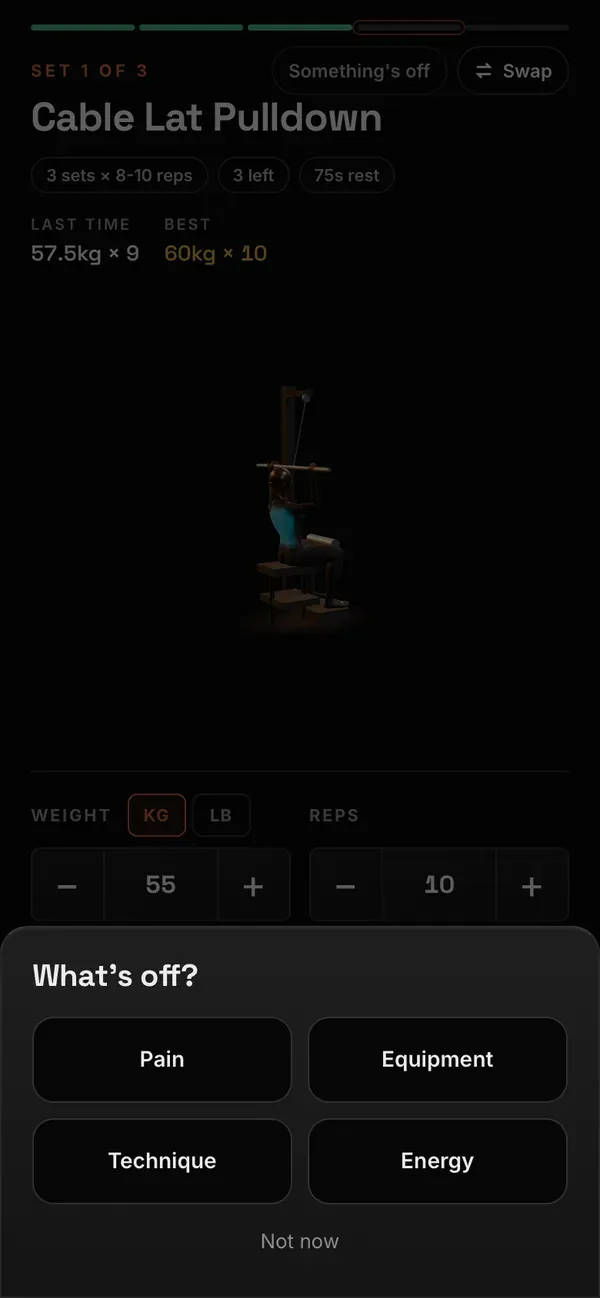
Sample member. Real screen.
The door
Built on real positions
Choose Move better for life and the app picks from programs built on getting up from the floor, carrying, and holding a position under load. It tells you why it chose the one it did, and lists the others beneath it.
Areas to protect
Tell it what to look after
The first run asks whether there is an area to protect, and says what each one means.
- KneesDeep knee bends, jumping
- ShouldersOverhead pressing
- Lower backHeavy spinal load, loaded bending and twisting
The app prefers programs that load those areas less, and tells you how many movements in your program still do. It is not medical screening, and it does not make any movement safe for you. Talk to a doctor before you start if you have a medical condition or an injury.
Getting started
From the first session
- New to this
- Tell it you are new and it starts you on a foundations program, never six days a week.
- Anywhere
- With no equipment, the app builds the session from your bodyweight. Add dumbbells or bands at home and it uses them.
- When something hurts
- Something's off is one tap on every set. Pain notes it, then lets you stop the exercise or swap it, and the week holds that muscle's sets.
- Every movement shown
- Every movement is demonstrated, so the first time you try one is not the first time you see it.
In Vancouver
Coached in person, if you can
One of the papers below found supervised training did more than unsupervised for older adults. If you are in Vancouver, strength for life is the same idea, coached 1-on-1 at the studio.
The research
What the research says about strength for life
Four papers, each one linked. One of them favours a coach in the room, and we say so.
Peterson, Sen, Gordon, 2011 · Med Sci Sports Exerc
Meta-analysis · 49 studies · 1,328 adults aged 50 and over
Lifting added 1.1 kg of lean mass on average. Higher-volume programs added more, and older participants gained less.
Read the paper by Peterson, Sen, Gordon, 2011 (opens in a new tab)Lepley, 2015 · Sports Health
Review of the published studies after ACL reconstruction
Quadriceps strength averaged 23% below the other leg six months after surgery, and 14% below at twelve months. The review describes these as the deficits that remain when formal physiotherapy ends.
Read the paper by Lepley, 2015 (opens in a new tab)Currier, D'Souza, Singh et al., 2026 · Med Sci Sports Exerc
Position stand · 137 systematic reviews · over 30,000 people
The American College of Sports Medicine recommends progressive training, and says progression is not necessary for the first benefits but is likely a requirement for continued longer-term progress.
Read the paper by Currier, D'Souza, Singh et al., 2026 (opens in a new tab)Lacroix, Hortobágyi, Beurskens, Granacher, 2017 · Sports Med
Meta-analysis · 11 studies · healthy adults aged 65 and over
Supervised balance and resistance training improved balance and strength more than unsupervised programs, most clearly against programs with no supervised sessions at all. Few studies, of moderate quality.
Read the paper by Lacroix, Hortobágyi, Beurskens, Granacher, 2017 (opens in a new tab)
Research describes groups of people, not you, and none of it is a promise about you.
Frequently Asked Questions
Read on
The other goals
- Build muscleTone, shape or size, with the focus where you want it.
- Get strongThe squat, bench, deadlift and press, set from your own estimated max.
- Get leanerLifting the whole way down, with a heavy week held rather than piled on.
- Build an engineConditioning set per machine, with strength alongside it.
- Train for a raceA run or a hybrid race on the calendar, worked back from race day.
The Vanguard app
Try it on your own training
Fourteen days free, then $19.99 a month or $199 a year, in Canadian dollars. In your browser, on any phone or computer. Cancel in the app in two taps.