The Vanguard app · Get strong
Your max, read from every set
No test days. The squat, bench, deadlift and press, every target set from an estimated max that the sets you log keep current.
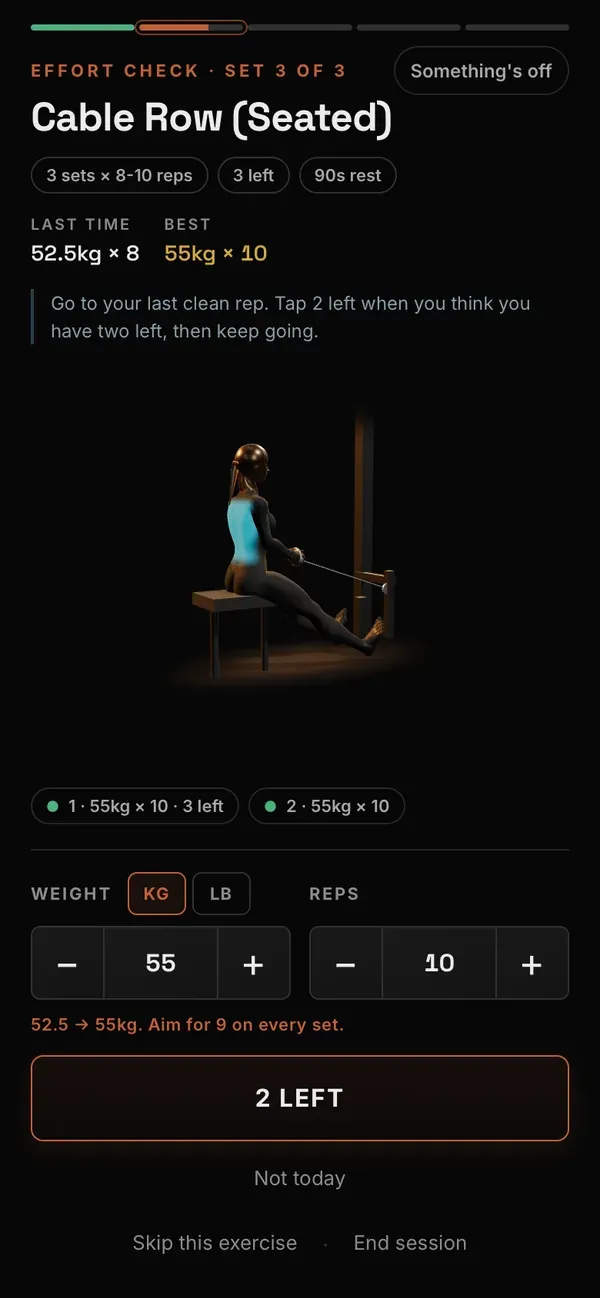
Sample member. Real screen.
Estimated max
An estimate, not a test day
What you could lift once, read from a set's weight, its reps and the reps you had left. Your targets are built from it, so a heavy triple and a set of ten count toward the same number. It is an estimate, most accurate from sets of ten reps or fewer.
- From your strongest recent sessions
- The estimate averages your strongest recent sessions, so one good day does not set your targets and one bad day does not take them away.
- No max testing
- You never have to lift a true max. The app reads the number from the sets you already do.
- One number everywhere
- The estimate on your Progress chart is the number your next target is built from.
- What changed today
- The finish screen lists each lift whose estimate moved, biggest first, and any load an effort answer changed.
Within normal variation. A change in an estimated max too small to be more than the day, up or down. One session's numbers move a little with sleep, food and the day, so a change this small is read as the day, not as a gain or a loss.
Week one
No test day to start, either
Before your first session, the app asks how you want to start: type the last good set of each main lift, or let the first outing find it.
- I know my numbersThe last good set of each main lift. The first target starts a little under it.
- Find my starting numbersEach lift starts light and builds to a set with two or three reps left.
Progression
Two ways a load climbs
In a rep range, the app keeps the weight and asks for a rep more until you own the top of the range on every set, then adds weight. On fixed reps, it sets the load from your estimated max at the reps and the effort the week asks for. Every load says what it was, what it is and why.
Barbell Back Squat
- 4 × 6-8
- 2 left
100 → 102.5kg. 8 on every set last time.
Barbell Bench Press
- 3 × 8-10
- 2 left
Same 80kg. Aim for 9 on every set.
The effort check
One set a block, measured
Once a block, one machine or dumbbell set goes to your last clean rep. You call two left, keep going, and the app counts the reps after the call. People tend to have more reps left than they think. After two checks your own count replaces the guess, so your targets can move up as well as down.
Never on a barbell, never in a Reset week, never on a movement with pain noted. A cap on how far a target can climb holds on every path, whatever the check says.
For trained lifters
A block written week by week
The Powerlifting Block is written out week by week. The app never hands it out as a first suggestion: it is there for a trained lifter to choose off the shelf.
The research
What the research says about getting strong
Six papers, each one linked. They are why the app reads your max the way it does.
Reynolds, Gordon, Robergs, 2006 · J Strength Cond Res
Prediction study · n = 70 aged 18 to 69
Predictions from a 5-rep max were the best (R² 0.993 bench, 0.974 leg press) and weakened at 10 and 20 reps; the authors advise 10 reps or fewer.
Read the paper by Reynolds, Gordon, Robergs, 2006 (opens in a new tab)LeSuer, McCormick, Mayhew et al., 1997 · J Strength Cond Res
Validation study · n = 67 untrained · seven equations
Predicted and tested maxes correlated above 0.95, yet most equations were off on average for bench and squat, and every one underestimated the deadlift.
Read the paper by LeSuer, McCormick, Mayhew et al., 1997 (opens in a new tab)Zourdos, Klemp, Dolan et al., 2016 · J Strength Cond Res
Validation study · n = 29 squatters
Effort rated by reps in reserve tracked bar speed: r = −0.88 in experienced lifters and −0.77 in novices. A 10 is no reps left, a 9 is one.
Read the paper by Zourdos, Klemp, Dolan et al., 2016 (opens in a new tab)Halperin, Malleron, Har-Nir et al., 2022 · Sports Med
Scoping review and meta-analysis · 12 studies · 414 people
People underpredicted their reps to failure by 0.95 on average; more accurate closer to failure, with heavier loads and in later sets.
Read the paper by Halperin, Malleron, Har-Nir et al., 2022 (opens in a new tab)Currier, Mcleod, Banfield et al., 2023 · Br J Sports Med
Network meta-analysis · 178 studies · 5,097 people
Loads above 80% of a max built the most strength; heavy, multi-set, three times a week ranked first. Every prescription grew muscle about equally.
Read the paper by Currier, Mcleod, Banfield et al., 2023 (opens in a new tab)Currier, D'Souza, Singh et al., 2026 · Med Sci Sports Exerc
Position stand · 137 systematic reviews · over 30,000 people
The American College of Sports Medicine recommends progressive training, and says progression is not necessary for the first benefits but is likely a requirement for continued longer-term progress.
Read the paper by Currier, D'Souza, Singh et al., 2026 (opens in a new tab)
Research describes groups of people, not you, and none of it is a promise about you.
Frequently Asked Questions
Read on
The other goals
- Build muscleTone, shape or size, with the focus where you want it.
- Get leanerLifting the whole way down, with a heavy week held rather than piled on.
- Move better for lifeGetting off the floor, carrying, holding a position under load.
- Build an engineConditioning set per machine, with strength alongside it.
- Train for a raceA run or a hybrid race on the calendar, worked back from race day.
The Vanguard app
Try it on your own training
Fourteen days free, then $19.99 a month or $199 a year, in Canadian dollars. In your browser, on any phone or computer. Cancel in the app in two taps.